.png)
.png)
.png)






Why Ontario's Modern Buildings Are Earthquake-Proof: A Construction Industry Guide
When a 3.7 magnitude earthquake struck near Orillia early this morning, January 28, 2026, it was felt across southern Ontario from Kitchener to Toronto, extending east to Belleville and south to Niagara Falls. While Earthquakes Canada confirmed there was no damage and none would be expected, the event sparked an important discussion: Are Ontario buildings really earthquake-proof?
The answer is yes and the science behind it is both fascinating and essential for modern construction. Ontario's updated building codes and innovative engineering practices ensure that contemporary buildings are designed not just to survive earthquakes, but to protect occupants and maintain operational functionality during and after seismic events. At HKC Construction, we're committed to building structures that meet and exceed these rigorous standards.
How Earthquakes Impact Buildings
Before we discuss earthquake-resistant design, it's important to understand the challenge. Earthquakes don't actually demolish buildings, seismic forces do. When an earthquake occurs, the ground shakes with inertial forces that buildings must be designed to resist. Traditional or poorly constructed buildings can experience:
Lateral (side-to-side) displacement
Structural cracking and failure
Collapse of non-structural components
Loss of occupancy after the event
Significant financial losses
Modern earthquake-resistant construction fundamentally changes this equation by creating structures with defined load paths that safely transfer seismic energy to the ground, preventing catastrophic failure.
Ontario's Seismic Design Requirements
Ontario's Building Code (OBC), particularly Part 4 on Structural Design, mandates that all new buildings include:
Seismic Force Resisting Systems (SFRS): Every building must have a clearly defined system designed to resist 100% of predicted earthquake loads. This system must transfer inertial forces generated during seismic activity safely to the supporting ground.
Importance Categories: Buildings are classified as Low, Normal, High, or Post-Disaster based on their use and occupancy. Critical facilities like hospitals, fire stations, and emergency response centers are designed to post-disaster standards, allowing them to remain fully operational immediately after an earthquake.
Spectral Response Acceleration Thresholds: Different regions of Ontario have different seismic risk levels. High-risk areas (like parts of the Ottawa and St. Lawrence valleys) require more robust design requirements.
Material Standards: The OBC specifies requirements for reinforced concrete, steel, and masonry to ensure they meet seismic performance criteria.
The Technology Behind Earthquake-Proof Construction
Modern earthquake-resistant buildings employ several innovative technologies and design strategies:
1. Base Isolation Systems
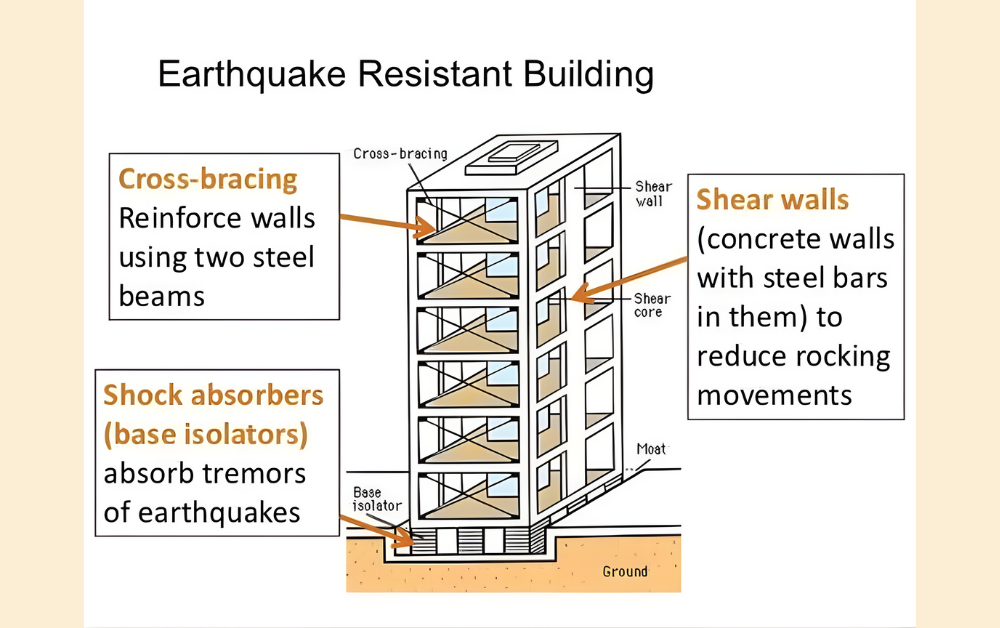
Base isolation is one of the most effective technologies for earthquake protection. This system uses specialized bearings or dampers that separate the building's superstructure from its foundation. Lead-rubber bearings with solid lead cores are particularly effective, allowing the ground to shake without directly transferring that motion to the building above.
Benefit: Reduces structural acceleration and protects building occupants from violent movements.
2. Advanced Damping Systems
Dampers work like shock absorbers in a car, absorbing and dissipating seismic energy:
Viscous Dampers: Contain specially formulated fluids that absorb earthquake shock waves
Friction Dampers: Reduce seismic activity by applying friction on specific surfaces
Tuned Mass Dampers (TMD): Heavy moving masses offset regular building movements, reducing swaying
Magnetorheological (MR) Dampers: Use smart technology to adjust stiffness in real-time
3. Shear Walls and Bracing
Shear walls are vertical structural elements made of reinforced concrete or engineered wood that resist lateral (sideways) forces. Diagonal steel cross-bracing is often used to transfer lateral forces directly to the building's foundation, similar to how diagonal bracing strengthens a bridge.
Benefit: Creates a rigid structural frame that prevents excessive deformation during earthquakes.
4. Reinforced Concrete Construction
Unreinforced concrete is brittle and cracks easily during earthquakes. Modern construction uses steel-reinforced concrete, where embedded steel bars provide:
Ductility (ability to flex without breaking)
Tensile strength (resistance to pulling forces)
Strong foundation anchoring
Benefit: Concrete becomes flexible enough to absorb seismic forces while remaining structurally sound.
5. Diaphragms and Connection Systems
Floors and roof structures act as diaphragms that distribute horizontal earthquake forces to vertical structural elements. Strong connections between walls, floors, and foundations prevent separation or failure.
Benefit: Ensures that seismic forces are distributed evenly throughout the structure rather than concentrated on weak points.
Commercial Building Applications
For businesses and commercial facilities, earthquake-resistant construction provides measurable benefits:
Operational Resilience: Post-disaster buildings continue operating after earthquakes, allowing businesses to maintain critical functions, protect employees, and minimize downtime.
Asset Protection: Advanced seismic design protects expensive equipment, inventory, and infrastructure from damage.
Enhanced Market Value: Properties built to higher seismic standards attract premium tenants, achieve higher rental rates, and maintain long-term value.
Insurance Advantages: Buildings meeting rigorous seismic standards qualify for reduced insurance premiums.
Regulatory Compliance: Meeting or exceeding OBC seismic requirements ensures permitting approval and legal compliance.
Cost-Benefit Analysis: Investment in seismic resilience typically generates a 6:1 return through avoided losses and operational efficiency.
Public Infrastructure and Critical Facilities
Ontario's most essential buildings hospitals, fire stations, police stations, water treatment facilities, and emergency response centers are designed to post-disaster occupancy standards. These buildings can resist seismic forces 1.3 to 1.5 times greater than standard commercial buildings, ensuring they remain fully operational immediately after earthquakes.
This isn't just about engineering excellence; it's about community safety. When hospitals can continue treating earthquake victims, fire stations can continue responding to emergencies, and water systems can continue operating, entire communities recover faster with fewer casualties and less economic disruption.
Why This Matters for Ontario
While earthquakes like today's 3.7 magnitude event are relatively minor in Ontario, the region is more seismically active than most people realize. The Ottawa and St. Lawrence valleys are among the most seismically sensitive areas in North America. Areas around Toronto have experienced multiple earthquakes of similar magnitude in recent decades.
Moreover, climate change is increasing the frequency of extreme weather events and environmental stress on infrastructure. Buildings designed for resilience, whether to earthquakes, wind, flooding, or other hazards, provide essential protection and business continuity.
How HKC Construction Delivers Earthquake-Resistant Buildings
At HKC Construction, we combine deep expertise in Ontario building codes, cutting-edge seismic engineering, and quality construction practices to deliver buildings that protect people and assets. Our approach includes:
Expert Design Collaboration: Working with structural engineers specializing in seismic design
Material Selection: Using earthquake-resistant materials including high-performance concrete and reinforced steel
Rigorous Compliance: Ensuring every project meets or exceeds OBC seismic requirements
Quality Construction: Precise installation of critical structural elements, connections, and systems
Post-Construction Verification: Testing and documentation confirming seismic performance specifications
Whether you're developing a commercial office tower, industrial facility, institutional building, or critical infrastructure project, HKC Construction has the expertise to deliver structures that are both beautiful and resilient.
The Future of Seismic-Resilient Construction
Building codes continue evolving with improved scientific understanding of earthquake impacts. The 2024 Ontario Building Code incorporates the latest research, with some regions now requiring structural elements to be 30-70% thicker and more robust than previous code requirements.
Emerging technologies like seismic cloaking (modifying soil and ground materials to redirect seismic waves), advanced computational modeling, and innovative materials like fiber-reinforced polymers promise even greater earthquake protection in the future.
Key Takeaways
Modern Ontario buildings are designed to resist earthquakes using proven engineering principles and technologies
Seismic design protects lives, assets, and business operations during and after earthquake events
Ontario's building codes mandate rigorous seismic requirements with different standards for different building types
Earthquake-resistant construction provides measurable financial benefits through property value, insurance savings, and operational resilience
Critical public facilities are designed to post-disaster standards ensuring communities can respond and recover quickly
Today's earthquake reminded us that nature is powerful and unpredictable. But thanks to modern construction practices and building science, Ontario's buildings stand ready to protect the people and businesses within them.
CONCLUSION
At HKC Construction, we believe that building excellence means building for resilience. When you choose HKC Construction, you're choosing a partner that understands building codes, respects engineering principles, and delivers structures that protect what matters most, your people, your assets, and your future.
Ready to discuss earthquake-resistant construction for your next project? Contact HKC Construction today.
Let's Build Resilient Infrastructure Together
At HKC Construction, we specialize in creating buildings that not only meet today's building codes but anticipate tomorrow's challenges. Whether you're planning a commercial development, industrial facility, or public infrastructure project, our expertise in seismic design and earthquake-resistant construction ensures your building is built to last.
Let's Build Something Great
START YOUR PROJECT INQUIRY
Ready to bring your vision to life? Fill out the form with details about your project. Our experts will review your inquiry and contact you to schedule a free, no-obligation consultation.
Tell Us About Your Project
Thank You!
Your inquiry has been sent successfully. An HKC construction specialist will be in touch with you shortly.
