.png)
.png)
.png)






Flood Analysis in Toronto and the GTA: A Simple Guide for Developers
Category: Land Development | Region: Toronto & GTA
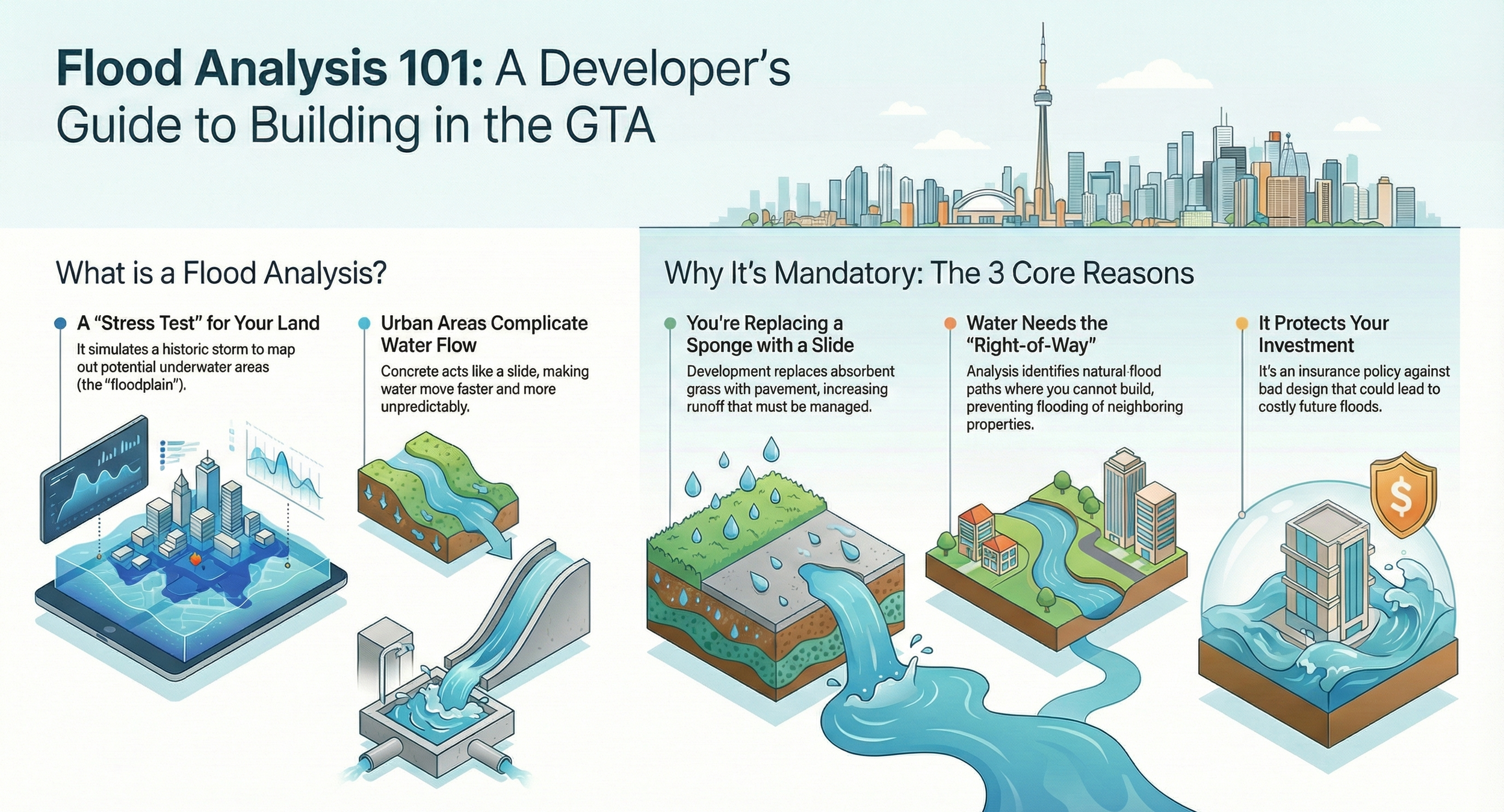
If you are planning to build something in Toronto or the GTA, you are going to hear one term over and over again: Flood Analysis. It sounds technical, but the concept is actually very simple. Before the City gives you a permit to pour concrete, they need to know the answer to one question: "If a massive storm hits, where will the water go?" At HKC Construction, we manage development projects every day. We know that ignoring water risks can shut down a job site fast. Here is everything you need to know about Flood Analysis, explained in plain English.
What Actually Is a "Flood Analysis"?
Think of Flood Analysis as a "stress test" for your land. Engineers take a digital map of your property and run a computer simulation. They pretend that a historic storm (like Hurricane Hazel) is happening right now.
The Goal: To see if your building stays dry and if the water flows safely away.
The Output: A map that shows exactly which parts of your land might end up underwater during a storm. This area is called the Floodplain.
Why Is This So Hard in the City?
If you are building in the countryside, water usually flows downhill into a creek. Simple.
But in a city like Toronto, it’s complicated.
Obstacles: Water has to squeeze under bridges, through culverts (pipes under the road), and around other buildings.
Concrete: Cities are covered in pavement. Pavement doesn't drink water; it acts like a slide. This makes water move much faster and more unpredictably.
Because of this complexity, you cannot just guess. You need trained professionals to model these "urban" risks.
Why Is It Mandatory? (The 3 Main Reasons)
You might think, "My land isn't near a lake, why do I need this?" Here is why the government requires it for almost every development:
1. You Are Changing the Land
Before you build, your land might be dirt or grass. Grass acts like a sponge: it soaks up rain.
When you build a parking lot or a warehouse, you are putting a "cap" on the sponge. The water can no longer soak in, so it runs off. You need to prove that this extra runoff won't flood the street or the sewer system.
2. You Can't Block the Path
Water needs the "Right of Way." If there is a natural path where water flows during a storm, you cannot build a wall or a house right in the middle of it. If you do, that water will back up and flood your neighbors. The analysis tells us exactly where these "No Build Zones" are.
3. Protecting Your Investment
This is for you. You don't want to spend millions building a new facility only to have the basement flood the first time it rains heavily. A flood analysis is your insurance policy against bad design.
How HKC Construction Helps You
At HKC Construction, we are Construction Managers. That means we handle the headaches so you don't have to.
We are not the engineers doing the math, but we are the team that makes sure the math works for your budget.
We Hire the Best: We bring in trusted experts (like specialized hydraulic engineers) who know the local GTA regulations inside and out.
We Interpret the Results: When the report comes back, we explain what it means for your wallet. If the report says "high flood risk," we might suggest raising the foundation or adding a stormwater pond.
We Get the Permit: The City and the Conservation Authority (TRCA) have strict rules. We package these reports correctly to ensure your building permit doesn't get stuck in paperwork purgatory.
The Bottom Line
Floods pose a danger to any land development, but they don't have to be a surprise.
By conducting a proper Flood Analysis early, we can identify the risks, engineer the solutions, and keep your people and property safe.
Planning a project in the GTA?
Don't navigate the regulations alone. Contact HKC Construction today, and let’s get your project started on solid, dry ground.
