.png)
.png)
.png)






Padel vs. Pickleball: What’s the Difference? (A Builder’s Guide)
Racket sports are exploding in popularity across North America. As the team that built The District Padel & Pickleball facility, HKC Construction has seen firsthand how much goes into creating the perfect environment for these games.
But if you’re new to the scene, you might be wondering: What is the actual difference between Padel and Pickleball?
In this blog, we’ll break down the sports and show you the "behind-the-scenes" of how we built one of Canada’s premier facilities.
1. The Court: Glass Walls vs. Open Space
The biggest structural difference is the design of the courts.
Padel Courts: These measure 10 meters by 20 meters and are enclosed by high glass walls and metal mesh. The walls are part of the game, meaning players can hit the ball off the glass.
Pickleball Courts: These are smaller (similar to a badminton court) and have no walls. The play is entirely open.
The Builder’s Note: Padel requires extremely precise concrete work. The ground must be perfectly level to ensure that the heavy tempered glass walls align correctly and the ball bounces predictably.
2. The Equipment
Padel: Players use a thick, stringless racket made of carbon fiber or fiberglass with small holes, and a pressurized ball similar to a tennis ball.
Pickleball: Players use a flat, solid paddle and a lightweight plastic ball with holes.
3. The Pace of Play
Padel is a highly dynamic "3D" sport because of the rebounds off the walls.
Pickleball is a fast-paced game of patience, quick reflexes, and placing the ball in the "kitchen" (the non-volley zone near the net).
| Feature | Padel | Pickleball |
|---|---|---|
| Court Size | 10m x 20m (enclosed area) | 6.1m x 13.4m (open area) |
| Walls & Glass | 3m high tempered glass & metal mesh walls (fully in play) | None (completely open court design) |
| Rackets / Paddles | Stringless, perforated carbon fiber or fiberglass racket | Solid composite, graphite, or wood paddle |
| Ball Type | Depressurized tennis-style ball | Perforated plastic ball (wiffle ball style) |
| Gameplay Style | Fast, three-dimensional play using wall rebounds | Tactical, focused on hand-eye reflexes and "the kitchen" zone |
| Primary Format | Almost exclusively played as doubles | Played as both singles and doubles |
CASE STUDY: The District Padel & Pickleball Club [Completed]
When building a massive commercial venue, you are not just installing courts you are building a complete community experience. Here are the project details for our build in Mississauga:
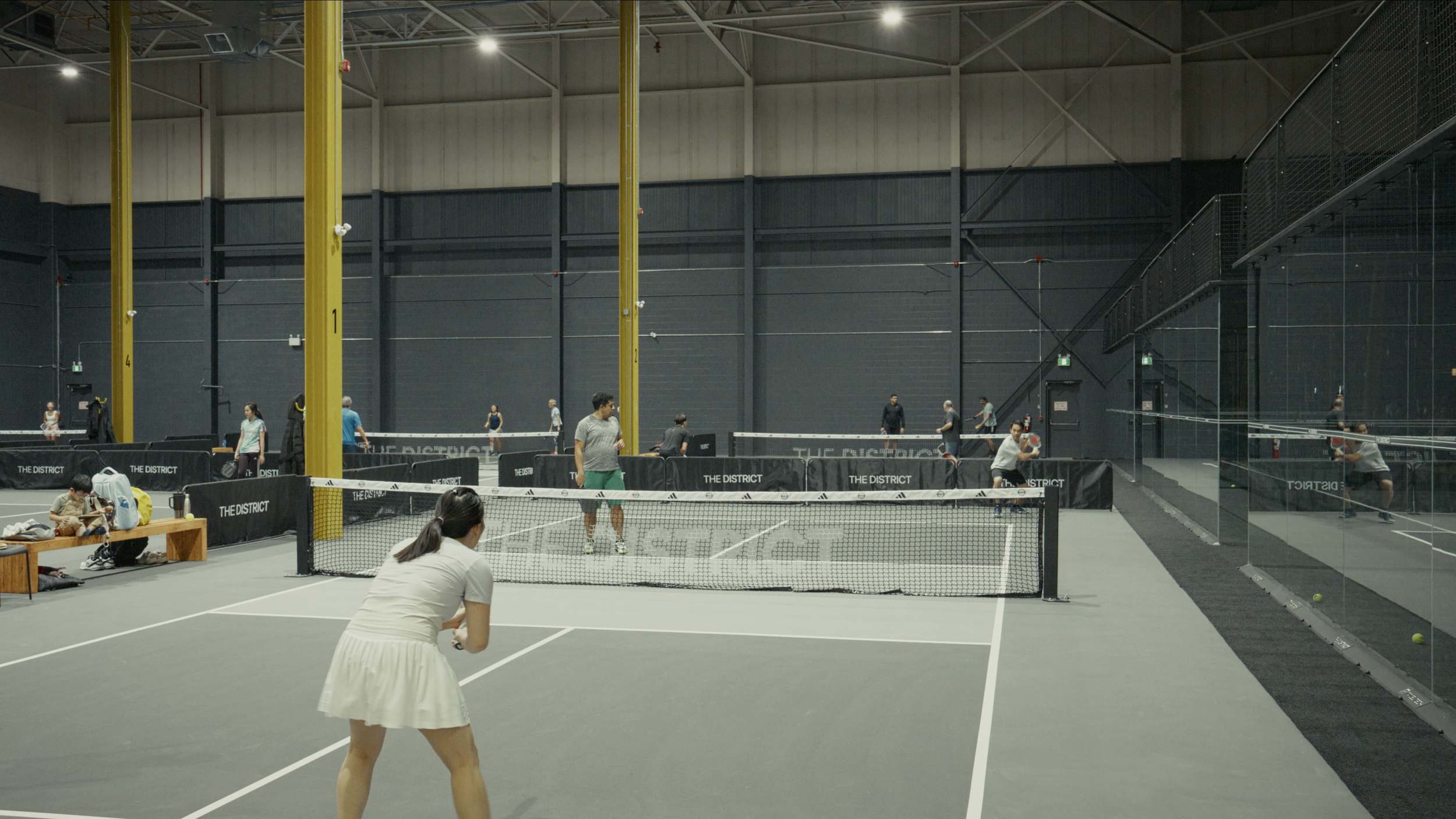
The District Padel & Pickleball Club
Completed Project Showcase | Built by HKC Construction
.png)
.png)
.png)
.png)
.png)
.png)
.png)
.png)
.png)
Project Type: Sports & Recreation Facility
Size: 55,000 Sq. Ft.
The Build Highlights:
8 premium indoor Padel courts
7 professional indoor Pickleball courts
A modern player cafe and juice bar
Comfortable spectator lounges
Private offices and co-working spaces for members
How We Did It:
Acoustics & Space Planning: With 15 courts inside a 55,000 Sq. Ft. space, managing sound was essential. We built the facility to keep court noise separated from the quiet lounge and office spaces.
Structural Integrity: Padel glass structures are incredibly heavy. Our engineering team designed reinforced concrete slabs to securely support the heavy steel and glass frames.
Pro-Grade Lighting: We installed shadow-free, no-glare LED lighting so players never lose sight of the ball mid-match.
Want to Build Your Own Sports Facility?
The District Padel & Pickleball Club is a great example of what happens when quality construction meets modern sports design. Whether you want to build a private court or a large-scale commercial sports center, HKC Construction has the expertise to make it happen.
We manage the entire process, including:
Concrete foundation and slab leveling
Glass and metal structure installation
Professional court surfacing and turf laying
Clubhouse, cafe, and lounge buildouts
Build Your Padel & Pickleball Facility
From multi-court commercial indoor clubs to private outdoor estates, HKC Construction specializes in professional court infrastructure engineered for the Canadian climate. As the builder of major facilities like The District, we understand the technical specifications for concrete leveling, steel structures, and glass installation. Let us help you navigate your project footprint, zoning, and site layout.
