.png)
.png)
.png)






Canadian Auto Manufacturing: Industrial Growth, Supply Chains, and Costs
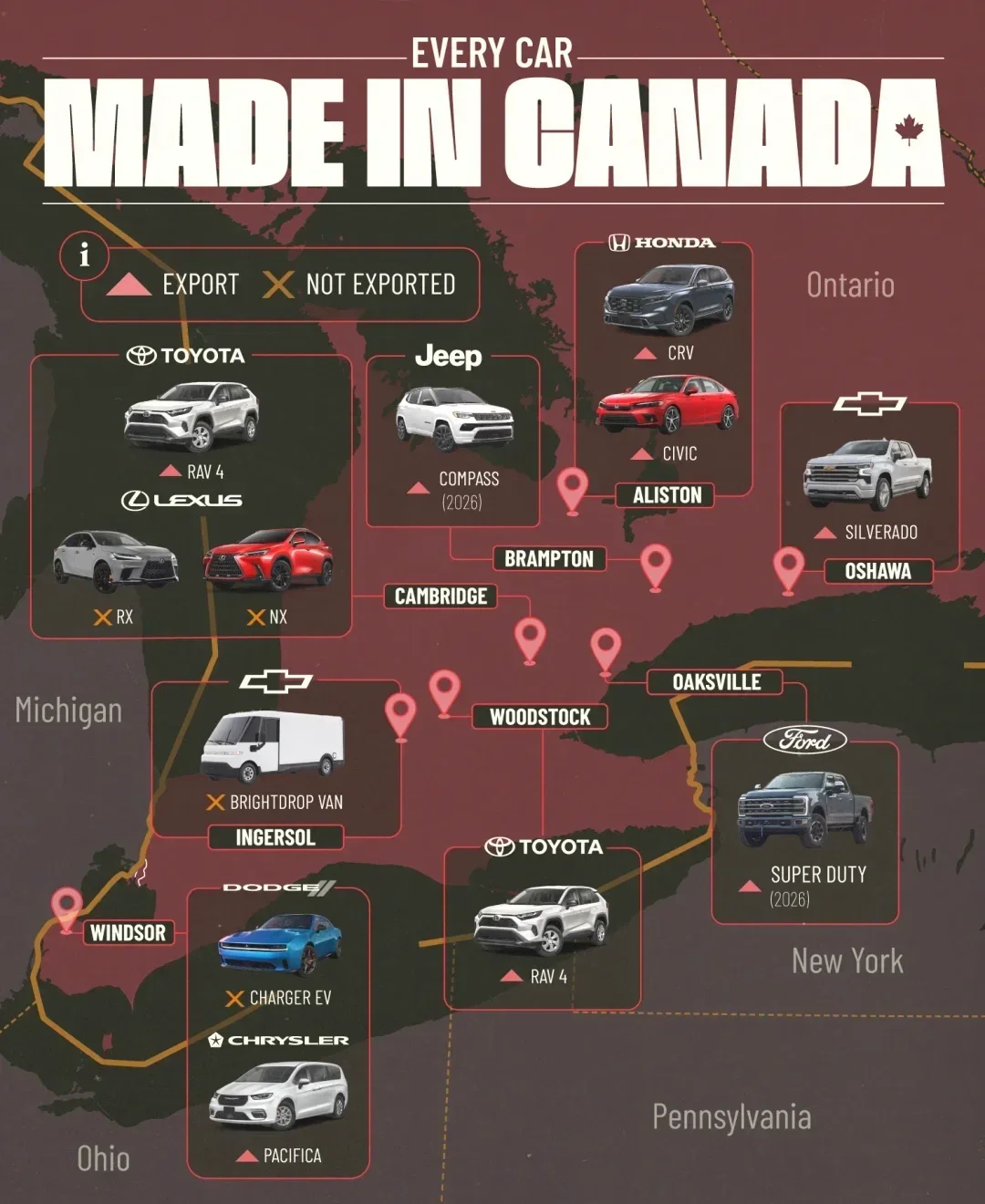
Canadian auto production is built to last, non-negotiable, and integral to the entire North American supply chain. Safeguarding domestic manufacturing plants against shifting global trade dynamics and punitive trade measures is about more than balancing ledgers, it is about protecting world-class assembly lines, advanced industrial facilities, and the skilled workers who power them.
What Vehicles Are Built in Canada?
From compact commuters and luxury SUVs to heavy-duty pickups and specialized two-wheelers, Canada builds some of the most recognizable machines on the road:
Compact & Sedans: Honda Canada Inc. Civic (Alliston, Ontario)
SUVs & Crossovers: Toyota Canada Inc. RAV4 (Cambridge & Woodstock, Ontario), Lexus RX & NX (Cambridge, Ontario)
Minivans & Muscle: Chrysler Dodge Jeep Ram Pacifica (Windsor, Ontario), Dodge Charger (Windsor, Ontario)
Trucks: Chevrolet Silverado & GMC Sierra (Oshawa, Ontario)
Motorcycles & Specialized Rides: Can-Am Xsports / BRP (Valcourt, Quebec), Campagna Motors (Boucherville, Quebec), and Havoc Motorcycles (Prince Edward County, Ontario)
Our industrial ecosystem thrives because of the dedicated work of organizations like Unifor, the United Steelworkers (USW), the Automotive Parts Manufacturers Association (APMA), and the Canadian Vehicle Manufacturers Association (CVMA).
To future-proof our manufacturing sector and shield our workforce from international policy swings, industry stakeholders advocate for three core domestic support measures:
Made in Canada Purchase Rebates: Direct tax relief or vehicle purchase incentives for buyers choosing models assembled locally.
Fleet Procurement Mandates: Requiring public sector fleets at all levels to prioritize Canadian-assembled vehicles and motorcycles.
Manufacturing Innovation Tax Credits: Enhanced tax breaks for original equipment manufacturers reinvesting in local assembly tooling, automation, and supply chain localization.
Expanding Industrial Footprints: What Does It Cost to Build a Manufacturing or Warehouse Facility in Canada?
As the Canadian automotive and manufacturing sectors localize supply chains, reshore production, and invest in high-tech assembly plants, understanding industrial construction economics is critical for accurate capital expenditure planning. Regional benchmark data outlines typical hard construction costs for industrial assets across major Canadian metropolitan markets:
| Metropolitan Market | Warehouse (Per Sq. Ft.) | Distribution Facility (Per Sq. Ft.) | Site Servicing (Per Acre) |
|---|---|---|---|
| Vancouver | $120 – $200 | $200 – $485 | $136,600 – $250,000 |
| GTA (Ontario) | $75 – $180 | $170 – $480 | $165,000 – $252,300 |
| Calgary / Edmonton | $130 – $175 | $155 – $475 | $145,000 – $241,500 |
| Montreal | $120 – $185 | $165 – $445 | $154,000 – $235,000 |
| Halifax | $125 – $195 | $165 – $430 | $130,000 – $205,000 |
| St. John’s | $115 – $180 | $185 – $480 | $155,000 – $225,000 |
Important Budgeting Note: These figures cover direct hard construction costs only. Comprehensive industrial development budgets must also factor in soft costs, which include land acquisition, legal fees, architectural and engineering services, municipal development charges, environmental site assessments, and specialized manufacturing equipment fit-outs.
Frequently Asked Questions (FAQs)
Q: What factors influence the cost of building a manufacturing or warehouse facility in Canada?
A: Key variables include regional labor availability, material volatility (such as steel and concrete pricing), site topography, soil conditions, municipal development charges, and specific building design standards or HVAC requirements.
Q: Do the estimated industrial construction costs include soft costs or land acquisition?
A: No. The benchmark figures reflect hard construction costs only. Project owners must separately budget for soft costs like architectural fees, permits, legal expenses, land surveys, and developer profit.
Q: Why do industrial construction costs vary significantly between Canadian cities?
A: Variations are driven by regional wage differences, local union agreements, climate-specific building code requirements (such as heavier insulation or advanced HVAC systems), and local supply chain logistics.
Q: Can these benchmark figures be used for final general contractor bidding?
A: These numbers serve as reliable guidelines for initial conceptual budgeting and feasibility studies. Final hard figures require detailed architectural drawings, structural engineering plans, and local trade tenders.
Build Your Manufacturing & Industrial Facility
From modern distribution warehouses to advanced manufacturing assembly plants, HKC Construction specializes in commercial and industrial infrastructure engineered for the Canadian climate. We understand technical specifications, site servicing, and structural steel execution. Let us help you navigate your next industrial project footprint.
Partnering with HKC Construction for Industrial Excellence
Building, expanding, or retrofitting a heavy manufacturing plant, automotive component facility, or regional logistics warehouse requires a specialized general contractor. You need a partner who understands complex structural requirements, local zoning laws, tight construction timelines, and volatile material markets.
At HKC Construction, we deliver robust, high-performance industrial spaces engineered to support Canada's economic backbone. Whether you are scaling up production or developing a greenfield logistics park, our team brings the technical expertise required to keep your project on schedule and on budget.
The months ahead will require serious resilience as market conditions shift. But when our industries stand shoulder-to-shoulder, sector-by-sector, province-by-province, we cannot be divided.
Let us back our workforce, protect our industrial capacity, and build a stronger, self-reliant Canada.
Join the movement: Show your support for Canadian workers and businesses by adding the Canadian flag to your professional profile picture or display banner.
