.png)
.png)
.png)






Warehouse Construction Cost Guide per square foot Ontario
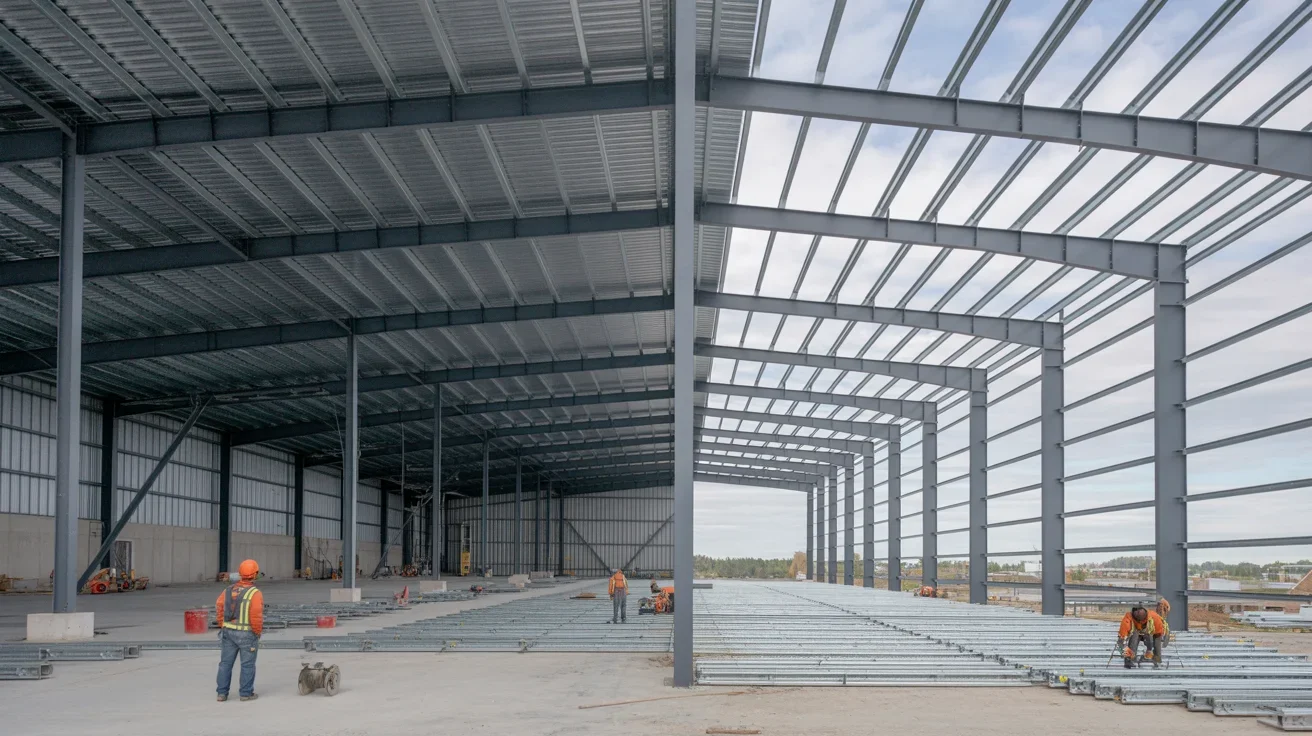
For any business involved in logistics, manufacturing, or e-commerce, a warehouse is the operational heart of the enterprise. As demand grows, the decision to build a new warehouse in Ontario becomes a critical strategic move. The first, and most important, question that every stakeholder asks is: "What is the real cost to build a warehouse per square foot?"
Getting an accurate answer is the bedrock of your entire project, it informs your budget, financing, site selection, and design. As a coast-to-coast industrial construction leader with deep roots in Ontario, HKC Construction has developed this definitive guide to provide a transparent, data-driven look at what it truly costs to build a warehouse in today's market.
Ontario Warehouse Construction Costs: The 2025 Per Square Foot Data
Let's start with the numbers. The cost to build a warehouse is a spectrum, not a single number. It's influenced by your location, the complexity of the building, and the specific needs of your operation. This table provides current, all-in costs for the base building shell and core.
Warehouse Construction Cost Guide (Q3 2025)
CAD per Square Foot (Base Building Shell)
| City/Region | Typology / Complexity | Low Range (CAD/psf) | High Range (CAD/psf) | Key Reference |
|---|---|---|---|---|
| Toronto / GTA | Standard Distribution Warehouse | 115 | 175 | 3 |
| Secondary ON CMAs | Standard Distribution Warehouse | 100 | 160 | Interpolated |
| National CMAs | Basic Storage Warehouse (Lowest Tier) | 80 | 100 | 9 |
| Calgary | Standard Distribution Warehouse | 140 | 200 | 3 |
| Vancouver | Standard Distribution Warehouse | 130 | 185 | Interpolated 7 |
Note: It is crucial to use current, localized data. Outdated figures from global reports, such as a C$124 psf cost for Toronto, do not accurately reflect today's labour, material, and regulatory costs in the Ontario market.
Deconstructing the Cost Per Square Foot: What Are You Actually Paying For?
The numbers in the table are the result of several key cost components. Understanding these is essential for accurate budgeting.
1. The Building Shell: More Than Just Steel
Pre-engineered steel buildings are the industry standard for their efficiency and speed. However, it's vital to understand what's included in cost estimates.
Steel Building Package vs. Erected Cost: You might see online ads for steel building "kits" for as low as 20-30 psf. This price is only for the unassembled steel beams and panels. It does not include design, foundation, labour to erect it, insulation, doors, or anything else. The true "shell" cost, as shown in our table, reflects a fully erected, weatherproofed structure on a foundation.
The Foundation: The concrete slab-on-grade is a ignificant cost. A standard 6-inch slab is the baseline. If your operation requires a thicker, reinforced slab (8+ inches) to handle heavy machinery or high-density racking, your foundation cost per square foot will increase.
The Envelope & Insulation: The walls and roof (the "envelope") and their insulation levels (R-value) are key cost factors. Higher R-values cost more upfront but deliver significant long-term savings on heating and cooling, a critical consideration in Ontario's climate.
2. Building Height: The True Cost of Volume
A critical metric for any warehouse is its "clear height", the usable vertical space. Building a warehouse with a 40-foot clear height is substantially more expensive per square foot than one with a 24-foot clear height. This is because it requires:
Larger, heavier steel columns and beams.
More extensive vertical wall paneling.
Thicker, more robust foundations to support the increased structural load.
3. Functional Systems: The Components That Make It Work
Loading Docks: A warehouse's efficiency is defined by its docks. Each position is a mini-project, including the overhead door, hydraulic dock leveler, dock seal/shelter, and reinforced concrete dolly pads. A facility with 30 docks will have a much higher cost per square foot than one with 10.
Fire Suppression Systems: This is a non-negotiable safety and insurance requirement. A standard system may suffice for some uses, but most modern distribution centers require an Early Suppression, Fast Response (ESFR) system to protect high-piled storage. ESFR systems require higher water pressure and more complex piping, adding to the cost.
Power & Electrical: The cost includes bringing sufficient power to the site and distributing it. A basic warehouse might need 400-amp service. A facility with automated conveyors or significant material handling equipment (MHE) charging stations may require 2,000-amp service or more, a significantly higher upfront investment.
From Construction Cost to Total Investment: Budgeting for the Full Project
The cost per square foot for the base building is the largest line item, but it's not the only one. A comprehensive project budget must include:
Hard Costs (Construction): The all-in cost for the physical building.
Soft Costs (approx. 10-15% of Hard Costs): These are the necessary "invisible" costs, including architectural design, engineering fees, municipal permit fees, and crucial Development Charges (which can be substantial in many Ontario municipalities).
Site Work Costs: This covers all work outside the building's foundation, such as asphalt paving for truck marshalling yards and parking, concrete curbs, stormwater management systems, and landscaping.
Interior Fit-Out: The cost to build out internal office spaces, washrooms, lunchrooms, and any specialized rooms.
FF&E (Furniture, Fixtures & Equipment): This is your budget for everything that goes inside the warehouse, from pallet racking and conveyor systems to office desks.
Contingency (10% of Hard Costs): A vital reserve fund to cover unforeseen challenges, ensuring the project is not derailed by unexpected issues.
The HKC Advantage: A Partner in Your Investment
Building a warehouse is one of the most significant capital investments your business will make. The success of that investment hinges on choosing a construction partner who can provide cost certainty and mitigate risk.
At HKC Construction, we operate on a one-stop, design-build model, providing a single point of accountability for your entire project. This integrated approach means:
Transparent Budgeting: We provide detailed, line-item budgets during the design phase, not after. This allows you to make informed decisions and control costs proactively.
Value Engineering: Our deep expertise allows us to identify potential savings through alternative materials or construction methods without compromising quality.
Navigating Ontario's complexities: We have extensive experience across the GTA and secondary Ontario markets. We manage the entire permitting and approvals process, saving you time and preventing costly delays.
Begin Your Project with Confidence
Your new warehouse is more than a building; it's the engine for your future growth. It starts with a realistic, data-driven financial plan.
Contact HKC Construction today for a detailed consultation. Let our team provide the clarity and expertise you need to turn your vision into a high-performance logistics facility, on time and on budget.
